The Netherlands Center for Occupational Diseases (NCvB) registers and reports occupational diseases via the national notification and registration system and a number of specific surveillance projects.
The Netherlands Center for Occupational Diseases (NCvB) registers and reports occupational diseases via the national notification and registration system and a number of specific surveillance projects.
The Netherlands Center for Occupational Diseases (NCvB) registers and reports occupational diseases via the national notification and registration system and a number of specific surveillance projects.
SIGNAAL is a new online service where suspicions about new relations between health and work can be reported and reviewed by a panel of occupational specialists: in the Netherlands the Occupational Health Specialists of the Dutch Centre for Occupational Diseases (NCOD) and in Belgium to Occupational Health Experts of the Centre for Environment and Health from KULeuven and the External Service for Prevention and Protection IDEWE. Submit your notification.
Work-related musculoskeletal disorders (WMSDs) are a key topic in occupational health. In the primary prevention of these disorders, interventions to minimize exposure to work-related physical risk factors are widely advocated. Besides interventions aimed at the work organisation and the workplace, interventions are also aimed at the behaviour of workers, the so-called individual working practice (IWP). At the moment, no conceptual framework for interventions for IWP exists. This study is a first step towards such a framework.
In this Cochrane Learning Live webinar on Thursday, 30 September, Dr Jos Verbeek will explain how presentation of effect sizes from the individual or population perspective can influence judgments about the importance of these effects and prevention strategies. Verbeek will provide guidance for systematic review authors on how to consider the individual and the population perspective.
The second review to which the Netherlands Center for Occupational Diseases (NCvB) contributes on ergonomic risks and the risk of 'osteoarthritis of hip or knee and selected other musculoskeletal diseases' has been published so that the World Health Organization and the International Labor Organization can calculate the worldwide work-related disease burden as accurately as possible, for this and other conditions: https://www.sciencedirect.com
Reporting COVID-19 as an occupational disease is important to gain insight into work situations in which infections arise and thus possibilities for the use of preventive measures, varying from workplace and work organization adjustments, personal protective equipment, to a future vaccination policy.
In the upcoming decades, hospitals and clinics around the world face a steep rise in demand from patients seeking knee replacement surgery. The largest increase in primary surgery demands is not among the classic knee arthroplasty population of patients aged 70 years and older, but among patients of working age. Until now, little-to-no attention has been given to work as a promising point of engagement for the prevention of knee OA and subsequent hospitalization, despite the unique opportunities that work offers.
Not only reducing smoking or drinking but also healthier work can make a difference. The Netherlands Center for Occupational Diseases estimates that 15-25% of tennis elbows are work-related and 6% of hearing loss. Curious what these figures are for burnout, COPD, irritative contact dermatitis and low back pain? Read the free article.
Occupational Skin Diseases prevention is one of the main objectives of Action TD 1206 StanDerm (“Development and Implementation of European Standards on Prevention of Occupational Skin Diseases”), a network of scientists representing 26 countries coordinating prevention-related activities across Europe, aiming to establish prevention standards by improving educational concepts and identifying susceptibility indicators.

 The Netherlands Center for Occupational Diseases (NCvB) registers and reports occupational diseases via the national notification and registration system and a number of specific surveillance projects.



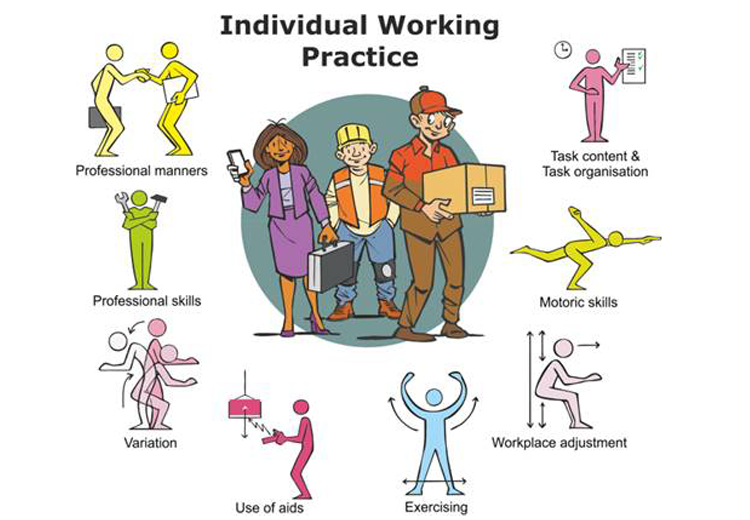 Work-related musculoskeletal disorders (WMSDs) are a key topic in occupational health. In the primary prevention of these disorders, interventions to minimize exposure to work-related physical risk factors are widely advocated. Besides interventions aimed at the work organisation and the workplace, interventions are also aimed at the behaviour of workers, the so-called individual working practice (IWP). At the moment, no conceptual framework for interventions for IWP exists. This study is a first step towards such a framework.
 In this Cochrane Learning Live webinar on Thursday, 30 September, Dr Jos Verbeek will explain how presentation of effect sizes from the individual or population perspective can influence judgments about the importance of these effects and prevention strategies. Verbeek will provide guidance for systematic review authors on how to consider the individual and the population perspective.
 The second review to which the Netherlands Center for Occupational Diseases (NCvB) contributes on ergonomic risks and the risk of 'osteoarthritis of hip or knee and selected other musculoskeletal diseases' has been published so that the World Health Organization and the International Labor Organization can calculate the worldwide work-related disease burden as accurately as possible, for this and other conditions:
  Reporting COVID-19 as an occupational disease is important to gain insight into work situations in which infections arise and thus possibilities for the use of preventive measures, varying from workplace and work organization adjustments, personal protective equipment, to a future vaccination policy.
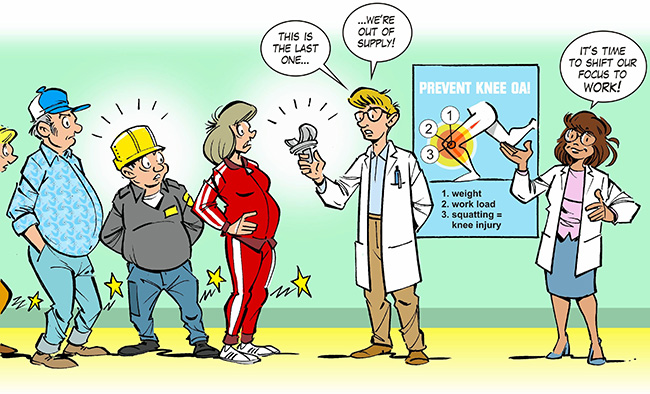 In the upcoming decades, hospitals and clinics around the world face a steep rise in demand from patients seeking knee replacement surgery. The largest increase in primary surgery demands is not among the classic knee arthroplasty population of patients aged 70 years and older, but among patients of working age. Until now, little-to-no attention has been given to work as a promising point of engagement for the prevention of knee OA and subsequent hospitalization,
  Not only reducing smoking or drinking but also healthier work can make a difference. The Netherlands Center for Occupational Diseases estimates that 15-25% of tennis elbows are work-related and 6% of hearing loss. Curious what these figures are for burnout, COPD, irritative contact dermatitis and low back pain?